Chat, Workflow, or Agent? A Beginner's Guide to Choosing the Right AI Pattern
A practical guide to Chat, Workflows, Routers, Agents, and Hybrid systems, centered on one question: who decides the next step?
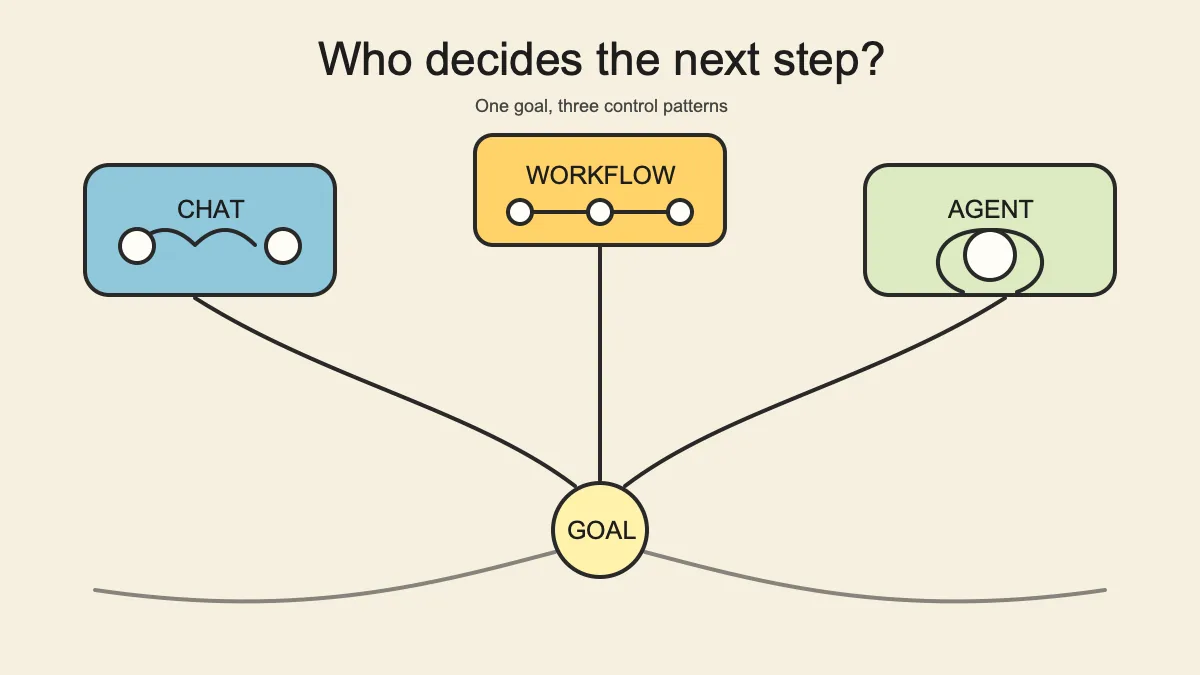
Almost every AI product wants to call itself an Agent.
Some are chat boxes with a few actions attached. Some use a model to select one of several predefined flows. Others genuinely inspect results, revise a plan, and keep working. They all look “more automated than chat,” but they are not the same engineering pattern.
If you remember only one sentence, remember this:
The useful way to distinguish Chat, Workflow, and Agent is not to ask whether the product has a chat box or calls an API. Ask who decides the next step.
You do not need to know function calling or Agent frameworks to follow this guide. We will begin with an ordinary task.
One request, three different systems
Suppose you say, “Plan a relaxing weekend trip for me with a budget of $500.”
Chat: you ask, it answers
A Chat system suggests destinations, itineraries, and things to watch out for. You read the answer, then decide whether to ask about weather, compare hotels, or change the budget.
1
You choose the next step → AI answers → you choose again
The model supplies information. The person advances the task.
Workflow: the route was designed in advance
A Workflow might execute:
1
read origin → check weather → search transport → filter hotels → build itinerary
If rain is forecast, it follows an indoor-attractions branch. If flights exceed the budget, it checks trains. The flow can be highly dynamic, but the allowed branches and transitions are generally written by developers beforehand.
Agent: give it a goal and bounded freedom to navigate
An Agent receives a goal, a set of tools, and constraints. It may clarify the departure city, inspect the forecast, replace a stormy destination, search a cheaper neighborhood, and stop when it has enough evidence to present a plan.
1
goal → observe → choose an action → receive a result → decide again → finish
None of these patterns is inherently superior. They assign control to the person, the program, and the model in different proportions.
First correction: these terms do not describe exactly the same dimension
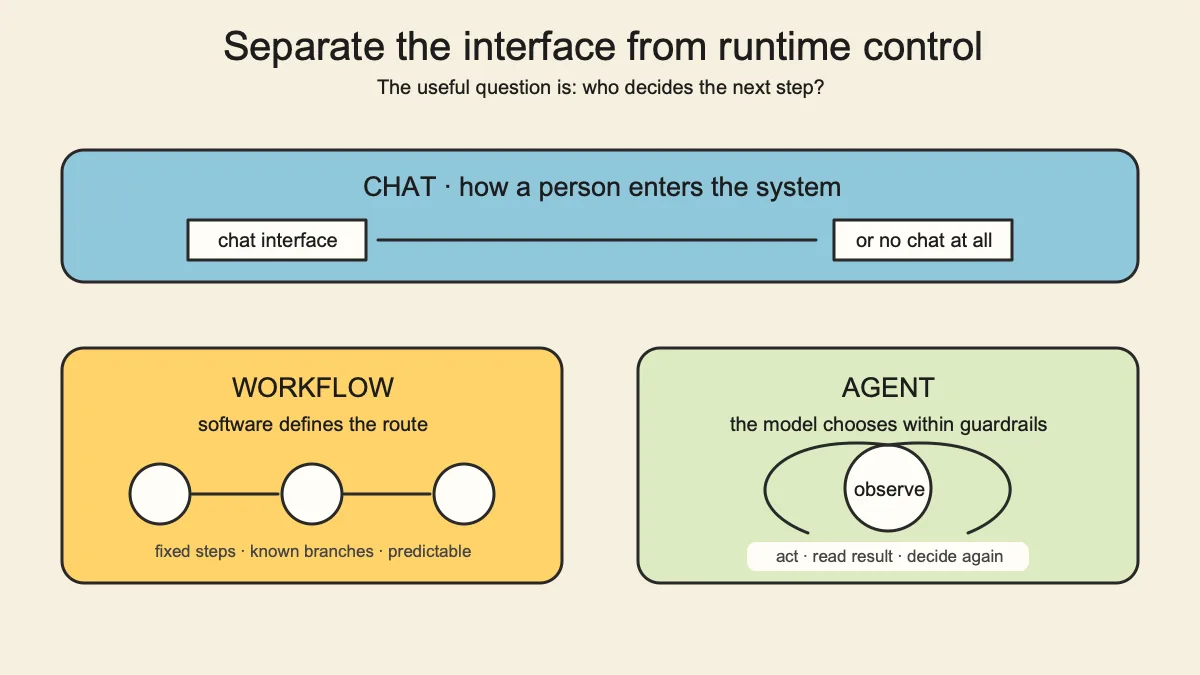
People often place Chat, Workflow, and Agent in one row. Strictly speaking, they answer different questions:
| Term | Primary question |
|---|---|
| Chat | How does a person communicate with the system? |
| Workflow | How does software prearrange the steps? |
| Agent | Who chooses the next action at runtime? |
A chat interface can therefore sit in front of a plain model, a Workflow, or an Agent. An Agent can also run in the background without any chat interface.
Common combinations include:
- Chat UI + model: you ask and it answers.
- Chat UI + Workflow: one message launches a predefined process.
- Chat UI + Agent: you provide a goal and the system keeps using tools.
- Workflow + Agent: the outer process is fixed, while one uncertain stage is delegated to an Agent.
That is why the presence of a chat box tells you almost nothing about whether a system is agentic.
Chat: the person remains inside the decision loop
Chat does not mean “a weak model.” It means that the person retains the responsibility for advancing the work.
Chat is a strong fit for:
- explanations, brainstorming, and discussing options;
- drafting a paragraph or summarizing a document;
- high-risk work that requires confirmation at each step;
- short problems whose true objective emerges through conversation.
Its advantages are transparency and cheap correction. You can immediately say, “That is not what I meant,” or “Stop before continuing.” Its limitation appears when a task becomes long: the person has to copy results, issue the next instruction, and notice missing steps.
Chat is not an inferior Agent. Keeping a human in the loop is often a deliberate control and safety choice.
Workflow: software defines the path
A Workflow resembles an assembly line. Input passes between nodes, while code defines available branches, retries, failure behavior, and destinations.
An educational app might process a problem like this:
1
image → OCR → classify problem → select solution template → format → return
Even if a model performs the classification, the overall system remains closer to a Router + Workflow when each label maps to a path designed in advance.
Workflows work well when:
- rules are stable and the task repeats frequently;
- each stage has a clear validation rule;
- approvals, billing, or data processing must be predictable;
- an error is too costly to permit open-ended experimentation.
Their tradeoff is that flexibility must be purchased in advance with code. An unseen case either fails, escalates to a person, or requires another branch. As branches multiply, the testing and maintenance surface grows with them.
Agent: the model receives limited runtime authority
The distinguishing feature of an Agent is not that it “has tools.” It is that the model uses the current goal, context, and tool results to decide what should happen next.
A minimal Agent usually needs:
- a goal and instructions: what success means and what is forbidden;
- context and state: what is known and what has already happened;
- tools: search, files, APIs, or other actions;
- a decision loop: continue, change strategy, or stop after observing a result;
- termination conditions: when the task is done and when it must escalate;
- guardrails: permissions, budget, time, approval, and validation.
Agents are useful when the path cannot be enumerated beforehand: open-ended research, multi-file code changes, complex diagnosis, and tasks whose intermediate findings change the plan.
The same freedom creates their cost. Runtime and token use vary; exact behavior is not fully reproducible; and a misunderstood goal can be pursued with alarming efficiency. More autonomy requires a clearer outer boundary.
From Router to Agent Loop: a spectrum, not a switch
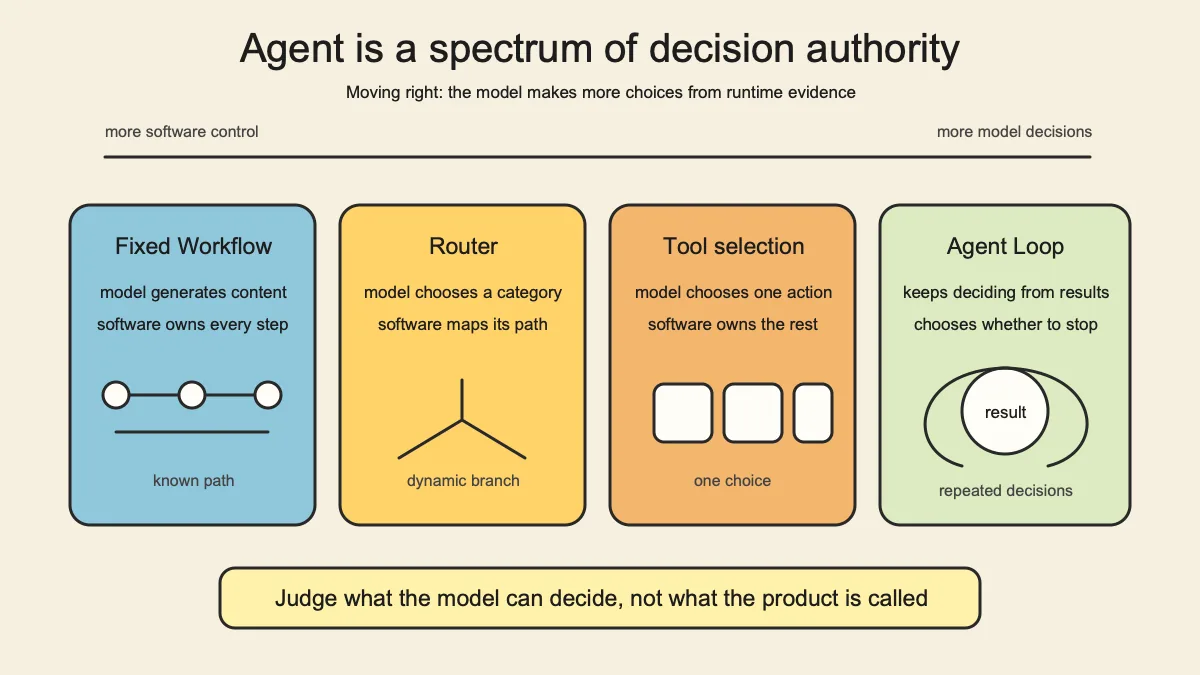
Real systems rarely occupy either extreme. A more useful model is a spectrum of delegated decision authority:
| Pattern | What the model decides | What software decides |
|---|---|---|
| Fixed Workflow | Content inside a node | Every step and transition |
| Router | One predefined category | The path associated with each category |
| Automatic tool selection | One action from an allowed set | The candidate set and the remaining flow |
| Constrained Agent Loop | Repeated actions and when to stop | Permissions, budget, tools, and hard gates |
Return to the problem-solving app:
- The model labels the problem and code selects a template: Router / dynamic Workflow.
- The model chooses a calculator, OCR, or search tool once: automatic tool selection with some agentic behavior.
- The model observes results, calls more tools, retries, changes strategy, and decides when to finish: a constrained Agent Loop.
The productive question is not merely “Is this an Agent?” It is: which decisions have we delegated to the model?
How to choose: uncertainty first, error cost second
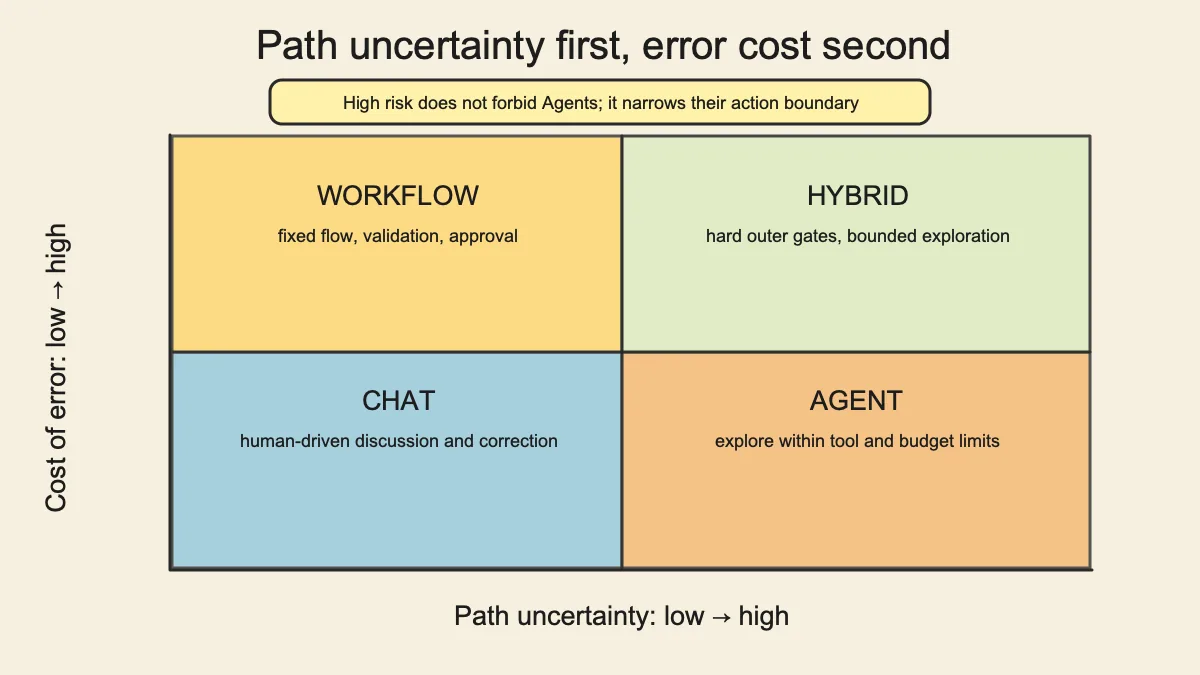
Ask four questions before choosing an architecture:
- Can the next step be specified in advance?
- Do intermediate results frequently change the plan?
- What does one wrong action cost?
- May the system continue without a person watching it?
This produces a practical rule:
1
2
3
4
5
6
7
8
9
10
11
The system only needs to answer, and a person will keep driving
→ Chat

The route is stable and the result must be predictable
→ Workflow

The route is unknown and must adapt to observations
→ Agent

The skeleton is stable but one stage requires exploration
→ Workflow + Agent
| Scenario | Sensible starting point | Why |
|---|---|---|
| Explain an error message | Chat | A person can immediately judge whether the answer helps |
| Generate the same monthly report | Workflow | The steps are stable and should be reproducible |
| Research an unfamiliar market | Agent | The search path depends on discoveries |
| Approve expense claims | Workflow | Money and authorization should not be explored freely |
| Fix a multi-file code defect | Constrained Agent | It must inspect, test, and revise its approach |
| Customer support | Hybrid | Route common cases; escalate uncertain cases to an Agent or person |
A safe principle is: do not convert a problem that a Workflow can solve reliably into an Agent merely to make it look intelligent. Use Agents for uncertainty that is real and worth the added operational burden.
Six common misconceptions
“It calls APIs, so it is an Agent”
No. Software that calls three APIs in a fixed order is still a Workflow.
“It has tools, so it is an Agent”
Tools are hands. What matters is whether the model can use results to make another decision.
“A Router is automatically an Agent”
A Router that maps input onto predefined paths remains a dynamic Workflow, whether rules or a model choose the label.
“Several prompts mean Multi-Agent”
They may be no more than template switching. Independent state, objectives, execution, and coordination matter more than persona names.
“An Agent is more advanced than a Workflow”
Payments, approvals, and migrations often demand determinism. Freedom is not maturity.
“More automation is always better”
Automation amplifies both correct and incorrect objectives. High-impact actions need permissions, approvals, rollback, and auditability.
Why production systems are usually Hybrid
Mature systems tend to combine both patterns:
1
2
3
fixed shell: authentication → validation → budget → approval → persistence → notification
                                      ↓
agentic core: search → tool choice → decomposition → recovery → candidate result
The outer Workflow supplies determinism and compliance. The inner Agent handles uncertainty. Its result returns to a predictable path for validation and persistence.
In one sentence:
A Workflow lays the track; an Agent searches for a route within the permitted section of that track.
Finally, do not begin with “Can we build an Agent?”
Begin with: where is the uncertainty, who should choose the next action, and who can detect and stop a mistake?
If a person should keep judging, use Chat. If the path can be specified, use a Workflow. Use an Agent only when observations genuinely need to change the plan and that freedom is worth its cost and risk.
Next: Agents Are a Spectrum: From Soft Routing and Tool Selection to an Autonomous Loop with Pi explains several internal Agent patterns and builds a minimal working example.
Further reading: The Complete Beginner’s Guide to OpenClaw · Harness Engineering: A New Engineering Paradigm for the AI Agent Era