Harness Engineering: A New Engineering Paradigm for the AI Agent Era
A systematic breakdown of Harness Engineering's core ideas, six components, OpenAI's million-line code case study, and strategic implications
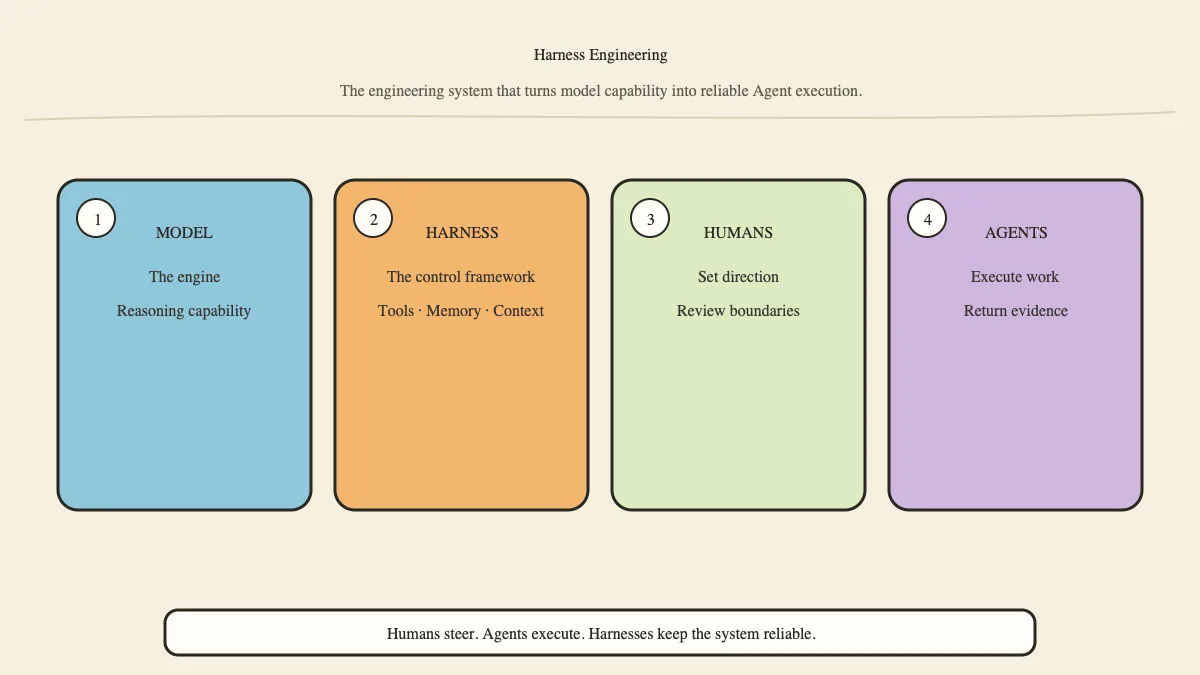
As large models become the new engines, what companies truly compete on is the “harness” used to control them—Harness Engineering is becoming a new engineering paradigm for the AI Agent era. This article systematically breaks down its core ideas, six core components, OpenAI’s landmark case study (3–7 engineers, five months, approximately one million lines of code, and zero handwritten code), and its strategic implications.
Audience: AI product managers and engineering teams
1. Conceptual Definition: From “Bare LLM Calls” to Harness Engineering
1.1 What Is Harness Engineering?
Harness Engineering is an engineering methodology for building a controllable, verifiable, and observable runtime shell around AI Agents. The word “harness” comes from horse tack: when an immensely powerful, untamed horse (the AI model) appears, people need to design an entire control system around it—reins, saddle, blinkers, signals, dashboards—not merely “shout instructions at it.”
OpenAI’s engineering team formally used the term in its February 2026 article, Harness engineering: leveraging Codex in an agent-first world, elevating it into a systematic engineering paradigm through an extreme experiment. In this article, Harness Engineering means systematically building constraints, tools, documentation, and feedback loops that enable AI coding agents to reliably get work done.
OpenAI engineer Ryan Lopopolo: “When the primary work of an engineering team is no longer writing code, but designing the environment, specifying intent, and building feedback loops, Harness Engineering is the systematic answer to that problem.”
The key to understanding this concept is not to conflate the following terms:
| Concept | Essence | Question answered |
|---|---|---|
| Prompt Engineering | Text engineering | How should we phrase a request so the model gives the right answer? |
| Context Engineering | Information engineering | What can the model see when making a decision? |
| Agent Harness | Technical artifact | Which modules make up the control plane that runs an Agent? |
| Harness Engineering | Engineering methodology | How do we design, build, and maintain a highly available Agent Harness? |
1.2 Technical Origins
Conceptual origin: Between November 2025 and March 2026, Anthropic published Effective Harnesses for Long-Running Agents and Harness Design for Long-Running Apps, offering systematic design guidance on persistence, checkpoints, error recovery, human intervention, and more.
Popularization of the name: OpenAI’s February 2026 “one million lines with zero handwritten code” experiment elevated the Harness idea into a complete Harness Engineering system.
Engineering implementation: From March to April 2026, open-source frameworks including SemaClaw, DeerFlow 2.0, and Symphony began implementing Harness Engineering.
1.3 Bare LLM Calls vs Harness Engineering
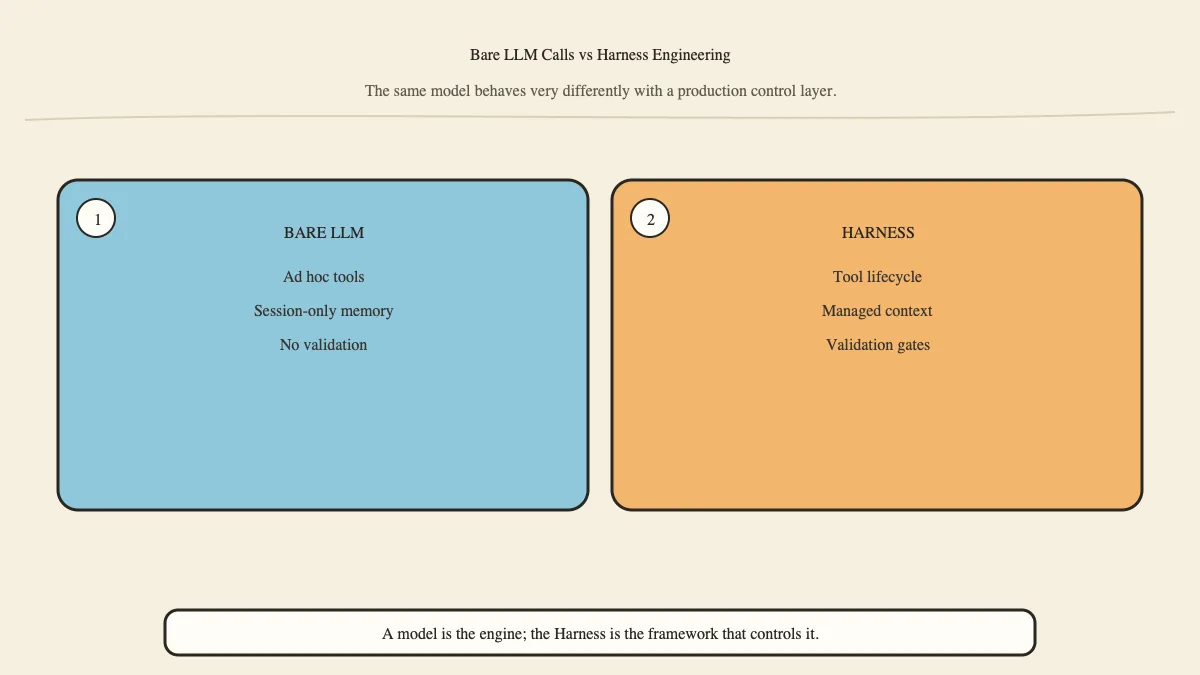
Bare LLM calls mean connecting a large-model API directly to the business. Every “non-reasoning” concern—tool invocation, memory management, context control, error recovery, and security auditing—must be assembled ad hoc in the calling layer. The usual result: an impressive demo and a disastrous production deployment.
Harness Engineering treats all of these “non-reasoning” concerns as first-class design and engineering responsibilities:
| Dimension | Bare LLM calls | Harness Engineering |
|---|---|---|
| Tool invocation | Assembled ad hoc, with high failure rates (some editing tools fail as often as 50.7%) | Full lifecycle management, standardized and observable tools |
| Memory | Stateless or session-only | Three layers: short-term + long-term + structured memory |
| Context | Window management left to chance; “Lost in the Middle” causes 30%+ performance loss | Precise injection, compression, and retrieval augmentation |
| Task orchestration | Single-step reasoning or random loops | DAG planning, subtask decomposition, and multi-Agent collaboration |
| Verification | No verification; results delivered directly | Rules engine + structural tests + human approval gates |
| Observability | Almost nonexistent | Traces, logs, metrics, and end-to-end auditing |
In one sentence: the model is the engine; the Harness is the framework that controls it. Without a Harness, the same engine is a wild horse. With one, it can become reliable productive capacity.
2. The Six Core Components
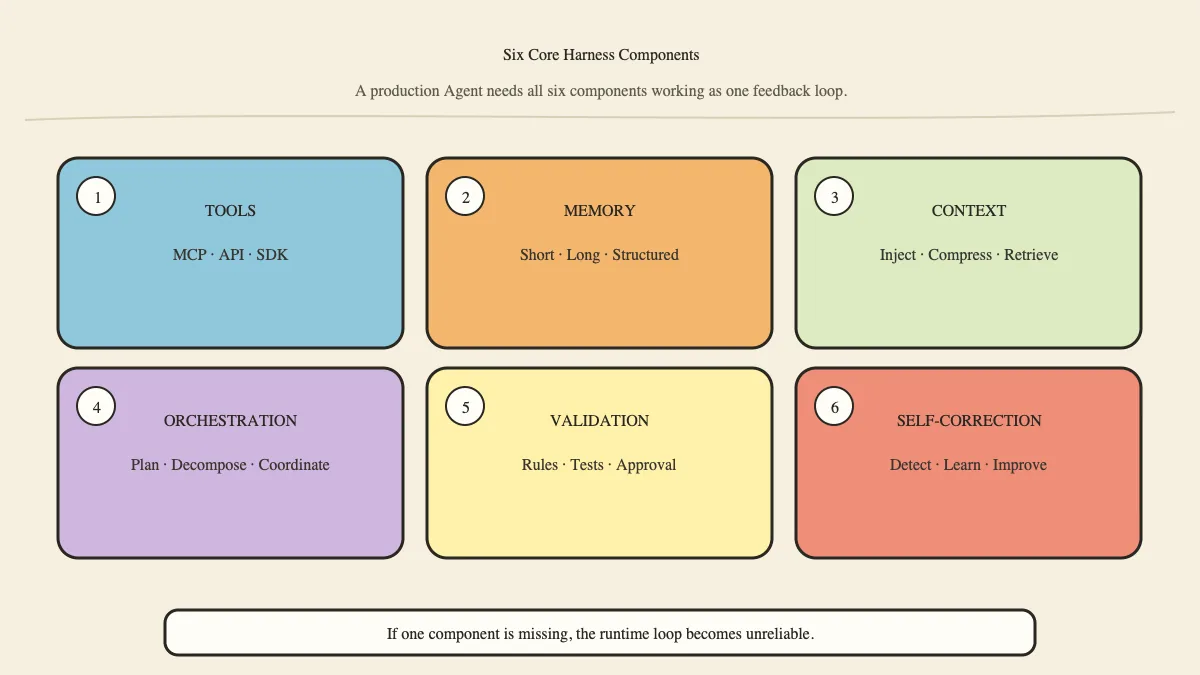
From a capability perspective, a production-ready Harness needs at least six core components working together. These are not a pile of features; they form the Agent’s runtime shell. If any one is missing, the Agent cannot run reliably in an enterprise environment.
2.1 Tools
Role: Extend the Agent’s “hands.” The tool layer packages operations a model cannot perform natively—reading and writing files, calling external APIs, running commands, and operating databases—into capability units the Agent can invoke.
Typical implementations:
Function Calling: JSON-Schema tool invocation natively supported by OpenAI / Anthropic / Google models and others.
MCP (Model Context Protocol): An open protocol proposed by Anthropic that provides standardized, plug-and-play connections between Agents and tools.
External API / system integration: Business systems, databases, SaaS, file systems, and CI/CD pipelines.
Key challenge: Tool specifications must be readable and verifiable. In February 2026, Can Bölük found that mainstream general-purpose editing tools had failure rates as high as 50.7% (when Grok 4 used patch format), primarily because their tool contracts were unfriendly to models. His solution, Hashline (line-level content hashes), lets a model edit precisely by referring to hash tags only two or three characters long.
2.2 Memory
Role: Give the Agent an ability to “learn continuously.” The memory layer treats “context” and “knowledge” differently, allowing an Agent to remain consistent within a session while reusing long-term accumulation across sessions and tasks.
Typical implementations:
Short-term memory: The current session’s conversation history, tool results, and intermediate variables.
Long-term memory: Vector stores (pgvector, Pinecone, Chroma) and structured memory (user preferences, decision logs, domain knowledge).
Knowledge capture: Externalizing insights derived from tasks into a corpus that users can own and retrieve, such as SOUL.md or an Agent Wiki.
Key challenge: Memory “garbage collection” and “knowledge distillation.” Log-style memory is only an archive, not knowledge. SemaClaw’s Knowledge Sedimentation emphasizes structuring task experience and externalizing it into reusable concepts.
2.3 Context Management
Role: Feed the model the right information, not more information. Context management offers the highest return on investment in a Harness; improving it often produces an immediate leap in capability.
Typical implementations:
Progressive disclosure: Instead of placing everything in the prompt, provide an entry file of roughly 100 lines (such as AGENTS.md) as a “table of contents” that directs the Agent to docs/ as needed.
Compression and summarization: When conversation or task history exceeds a window threshold, automatically compress it into a structured summary.
Retrieval-Augmented Generation (RAG): Dynamically retrieve relevant knowledge, code, and past decisions according to the task.
Key challenge: “Context Rot.” Stanford’s Lost in the Middle research and Chroma’s experiments both show that model performance drops by 30%+ when critical content falls in the middle of the context. This is precisely why OpenAI’s team abandoned the “ten-thousand-line AGENTS.md” approach for “Map, Not Manual.”
2.4 Task Orchestration
Role: Upgrade a single Agent into a “team” capable of handling complex tasks. Task orchestration decomposes a goal into parallel or sequential subtasks, assigns them to appropriate Agents or tools, and tracks dependencies and failures.
Typical implementations:
Planning: ReAct, Plan-and-Execute, Chain-of-Thought, and others.
Subtask decomposition: Break a large goal into subtasks represented as a DAG (directed acyclic graph).
Multi-Agent collaboration: A primary Agent schedules work, specialized Agents divide responsibilities, and Agents review one another, as in OpenAI’s Agent-to-Agent Review.
Key challenge: “Pseudo-orchestration”—an orchestrator in name that keeps all reasoning internal and never produces a verifiable, executable task graph. SemaClaw’s DAG Teams addresses this with a two-stage method: “LLM generates the DAG + deterministic scheduler executes it.”
2.5 Verification & Filtering
Role: Establish a “hard check” between Agent output and the real world. Verification and filtering constrain an LLM’s nondeterministic output within a deterministic contract, creating the fundamental dividing line between an enterprise Harness and a toy Agent.
Typical implementations:
Rules engine: Enforce business rules with deterministic code rather than prompts.
Structural tests: Automated tests for architecture patterns, module dependencies, and interface contracts—not functional tests.
Human-in-the-Loop: Force a pause for human confirmation before high-risk operations, corresponding to the “four-eyes principle” in corporate finance.
Key challenge: Verification is a “guarantee owned by code,” not a promise claimed by a prompt. The controlled experiments in the SemaClaw paper demonstrate that prompt instructions alone allow violating responses to leak to readers; only checks enforced by code can prevent them completely.
2.6 Self-Correction
Role: Give the Harness the ability to “learn from mistakes.” Self-correction redefines “failure” as a diagnostic signal that the system lacks a capability, then uses feedback loops to turn one-off fixes into lasting structural improvements.
Typical implementations:
Feedback loops: Hooks listen for corrective signals from users (“don’t do that,” “why does this keep happening?”) and automatically write them into a pending buffer.
Error detection: Run structural tests and error classification to identify drift in Agent behavior.
Iterative improvement: Encode recurring issues into lint rules, structural constraints, or SOPs, progressively containing entropy growth.
Key challenge: Agents “replicate patterns already in the repository—including bad ones,” as OpenAI’s team observed. A Harness must therefore perform active “garbage collection”: periodically run dedicated Agents to scan for contradictions, violations, and technical debt, and submit cleanup PRs instead of allowing entropy to accumulate.
Summary: The six components are not parallel features but a feedback loop—the tool layer provides hands and feet, the memory layer provides a cortex, context management provides the current field of view, task orchestration provides the workflow, verification and filtering provide quality control, and self-correction provides evolution.
3. OpenAI’s Landmark Case: Engineering One Million Lines of Code
If Anthropic laid the theoretical foundation for Harness Engineering in 2025, the extreme experiment OpenAI published in February 2026 brought it to broad industry attention.
3.1 Key Figures: Five Months, One Million Lines, Zero Handwritten
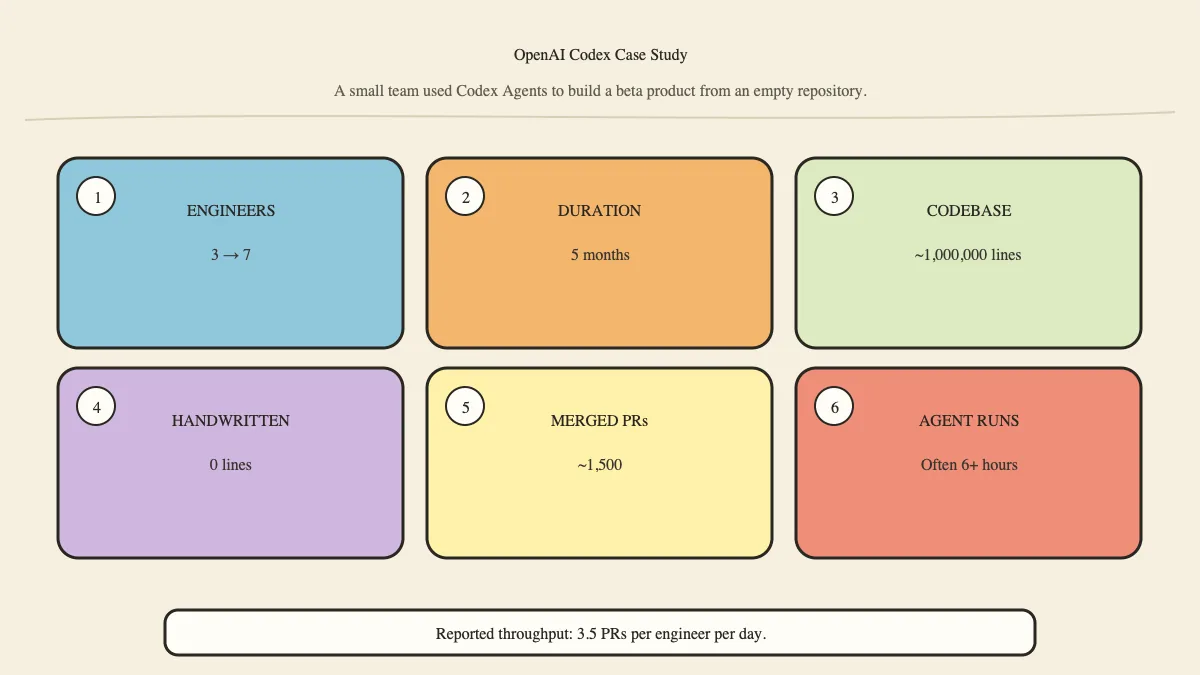
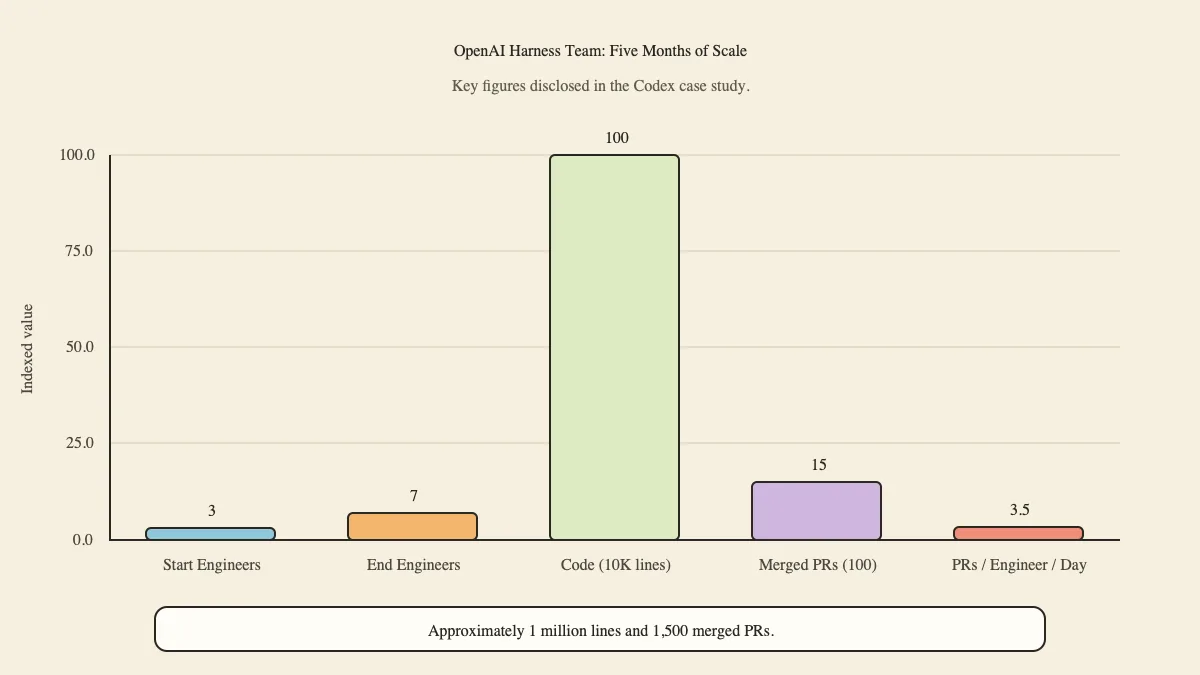
In August 2025, a small internal OpenAI team of three engineers—later expanded to seven—started from an empty repository. In only five months, and with zero lines of handwritten code, they used Codex Agent to deliver a Beta product containing approximately one million lines of real code.
The experiment disclosed the following figures publicly:
| Metric | Value |
|---|---|
| Team size | Started with 3 → expanded to 7 |
| Project duration | 5 months (August 2025–February 2026) |
| Codebase size | Approximately 1 million lines (including application logic, tests, CI, observability, and documentation) |
| PRs merged | Approximately 1,500 |
| Throughput per person | 3.5 PRs / engineer / day (and it continued to increase as the team grew) |
| Task duration | A single Codex run often lasted 6+ hours (frequently while engineers were resting) |
| Productivity per person | Equivalent to 3–10x human engineers |
| Time estimate | Approximately 1/10 the time required for handwritten code |
Two figures deserve the most thought:
3.5 PRs per engineer per day, roughly 5–10x the typical human pace.
Throughput increased as the team grew. This overturned Brooks’s Law (adding people slows a project down). The reason was that engineers shifted from “writing code” to “steering Agents + maintaining the Harness.” Adding people did not add coordination cost; it brought more investment into the Harness.
3.2 The Core Approach: Turn the Repository into an “Agent-Readable World”
OpenAI’s key insight was: “From the agent’s point of view, anything it can’t access in-context while running effectively doesn’t exist.”
The team therefore distilled its Harness Engineering practice into five principles:
Repo as System of Record—Externalize Slack discussions, Google Doc decisions, and tacit knowledge held in people’s heads into versioned artifacts in the repository (markdown, schemas, executable plans).
Map, Not Manual—Keep AGENTS.md to roughly 100 lines as an entry map pointing to deeper docs/. The team tried “one file containing everything,” but it crowded out context, weakened constraints, and let documentation rot.
Mechanical Enforcement—Enforce architectural constraints with custom linters + structural tests, not documentation and persuasion. If an Agent writes code that violates the architecture, CI fails immediately. Codex also wrote the linter itself.
Agent Readability—Prefer “boring but stable” technology stacks with high coverage in training data and stable APIs, avoiding obscure dependencies. When necessary, reimplementing a focused subset for the Agent can be more economical than wrapping an opaque upstream library.
Throughput Changes Merge Philosophy—When the number of Agents far exceeds human attention, “fix-forward” (rerun to repair) is usually more economical than “fix-perfect” (perfect repair). Short PR lifecycles and rerunnable tests become the default.
OpenAI’s team also implemented two critical engineering measures:
Enforced layered architecture: Dependency direction within a business domain was locked to Types → Config → Repo → Service → Runtime → UI; the linter directly rejected cross-layer dependencies.
Observability as an Agent tool: Chrome DevTools Protocol, Victoria Logs, and Victoria Metrics were connected directly to the Agent runtime, letting Agents inspect the UI, query logs, and inspect metrics like human engineers.
3.3 Results and Lessons: The Method Itself Is Replicable
The boundaries must be considered objectively:
This was a single experiment self-reported by OpenAI, on a greenfield project with no legacy burden.
One million lines alone proves nothing (“a bad system can produce code quickly too”). What is genuinely worth replicating is maintaining architectural consistency across 1,500 PRs over five months.
OpenAI has privileged access to and influence over the Codex product. External teams need more substantial Harness investment to reproduce the result.
But the method itself is transferable:
The “map pattern” of an AGENTS.md entry point + docs/ as the source of truth has been widely adopted through Claude Code’s CLAUDE.md.
Mechanically enforcing architecture with custom linters applies to teams of every size (Martin Fowler recommended it in an April 2026 article).
Agent review replacing human review is becoming a new norm in large codebases (OpenAI reported that by the end of 2025, approximately 70% of PRs company-wide were merged with AI assistance).
The experiment’s artifact, Symphony—an issue-tracker-driven Agent orchestrator—was open-sourced in April 2026. Within six months, it surpassed 25,000 GitHub Stars, and some internal teams increased delivered PR volume by 5x after adopting it.
The honest counterargument: If you still write most of the code yourself, or the project is a weekend prototype, do not build a Harness—that would be overengineering. Harness Engineering applies when Agents open multiple PRs in your codebase every day.
4. Strategic Implications: Models Are Commodities; the Harness Is the Moat
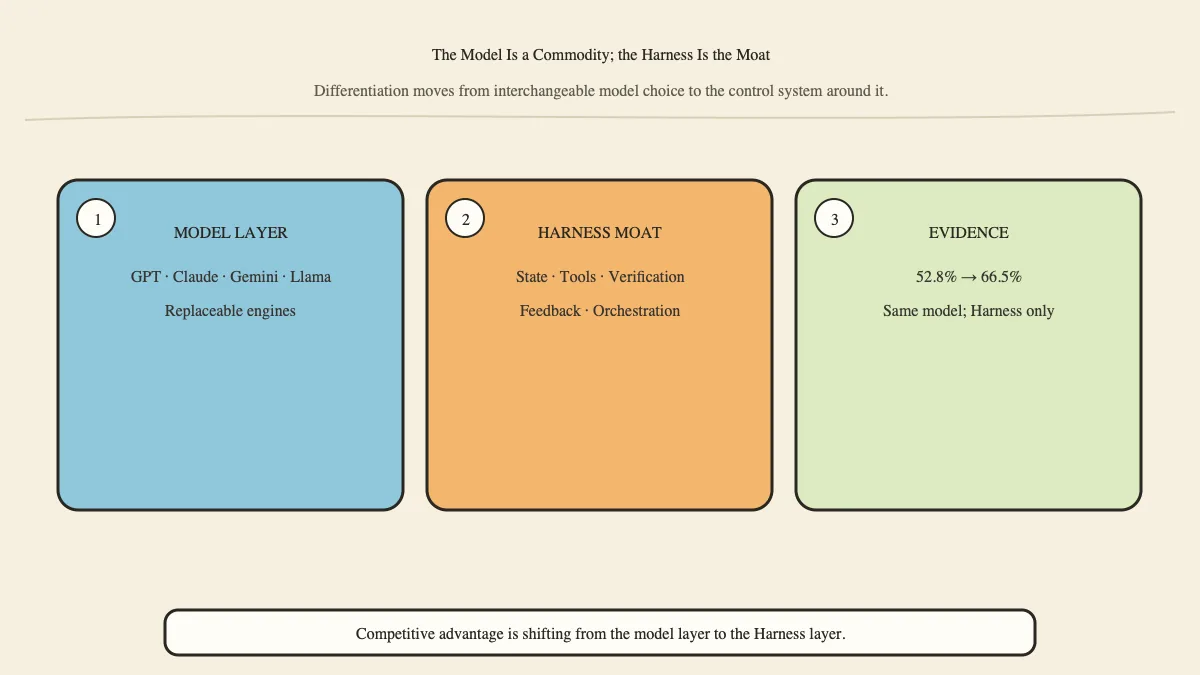
The deepest implication of OpenAI’s experiment is not “AI can write one million lines of code,” but that the moat is moving from the model layer to the Harness layer.
4.1 Differentiation Is Moving from the Model Layer to the Harness Layer
LangChain’s controlled experiment on Terminal Bench 2.0 provides the clearest evidence:
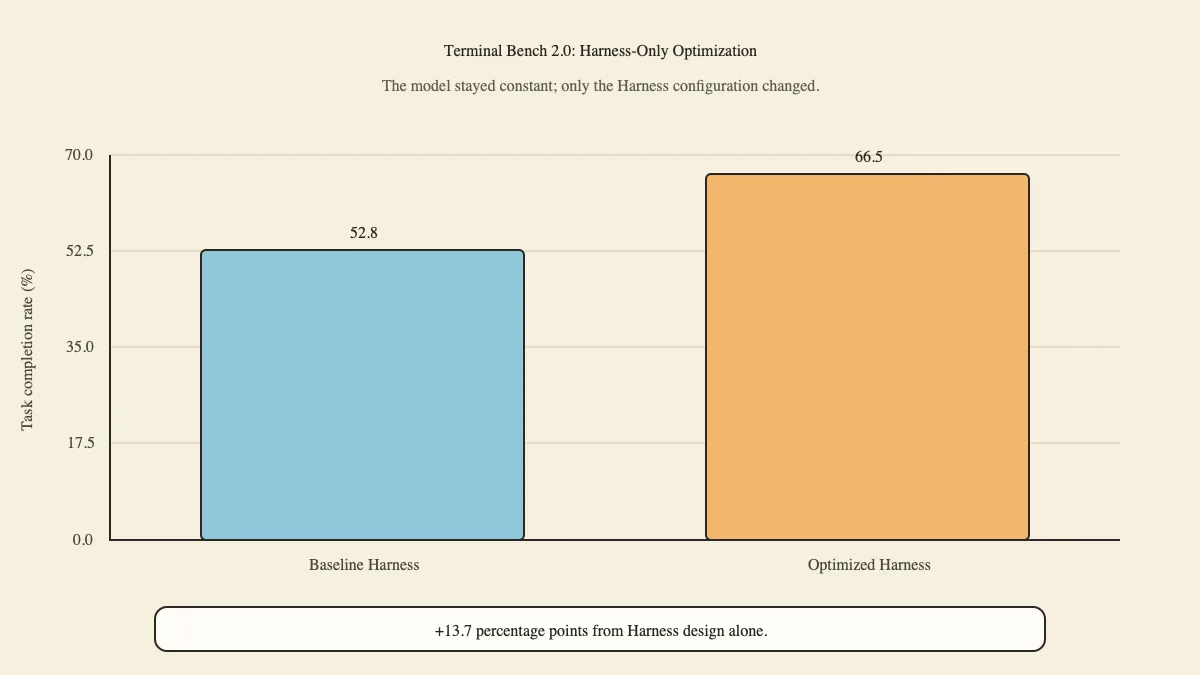
With the model held constant, optimizing only the Harness configuration raised a programming Agent’s Terminal Bench 2.0 task completion rate from 52.8% to 66.5%—a full 13.7 percentage-point gain attributable entirely to Harness design.
This means:
Replacing GPT-5 with Claude Opus 4.8 may produce a difference of only two or three percentage points;
But replacing “bare LLM calls” with a “mature Harness” may produce a difference of more than ten percentage points.
Differentiation at the model layer is rapidly converging:
| Trend | Observation |
|---|---|
| Capability convergence | GPT-5, Claude Opus 4.8, and Gemini 2.5 differ by less than 5% on mainstream benchmarks |
| Price convergence | Leading model API price tiers are compressing, with similar downward token-cost curves |
| Lower switching costs | A well-designed Harness can switch the underlying model in seconds |
| Training-data convergence | The public internet data dividend has been exhausted; proprietary synthetic data is the new variable |
At the same time, the moat at the Harness layer is deepening:
Toolchain accumulation: Proprietary MCP tools and domain-specific function libraries
Data accumulation: Long-term memory, user preferences, and domain knowledge bases
Process accumulation: Validation rules, regression tests, and approval gates
Feedback accumulation: Failure-mode libraries, error classifications, and repair playbooks
4.2 Implications for AI Product Teams
For today’s AI product managers and engineering teams, Harness Engineering suggests five practical actions:
Do not bet on one model; bet on Harness portability. Treat the model as a replaceable commodity and the Harness as an evolving asset. Anthropic calls Claude Code a “mature example of Harness Engineering” precisely because its explicit context lifecycle, persistent-state isolation, hook execution control, and incremental skill loading are insensitive to model changes.
Begin with one dimension, such as “context engineering” or “architectural constraints.” Do not try to build a “complete Harness system” all at once. Start from the most painful problem—hallucinations, overreach, poor reproducibility?—solve that point, and expand afterward.
Redefine “failure” as “the system lacks a capability.” When an Agent makes a mistake, do not ask “why did the Agent fail?” Ask “what capability does the Agent lack, and how can I make that capability readable and verifiable?” This is the capability completion mindset OpenAI’s team repeatedly emphasizes.
Encode architectural constraints as machine-executable rules. Documentation rots; linters do not. Translate requirements such as “module dependency direction” and “error-handling conventions” into structural tests and custom linters so an Agent does not cross boundaries even when unattended for 6+ hours.
Establish a “garbage-collection Agent” as a long-term mechanism. Every one or two weeks, run a scanning Agent to identify architectural drift, documentation contradictions, and technical debt, then submit cleanup PRs. Give the Harness itself the ability to evolve.
Conclusion: OpenAI’s one-million-line code experiment ultimately answered one question: As the marginal capabilities of models converge, who can safely, controllably, and sustainably turn AI into business value? The answer is Harness Engineering.
Competition in 2026 is no longer about “whose Agent is smarter,” but “whose Harness is more complete.” Investing in the Harness as a first-class concern is the highest-ROI engineering decision an AI product team can make today.
References
OpenAI. Harness engineering: leveraging Codex in an agent-first world. 2026-02.
Anthropic. Effective Harnesses for Long-Running Agents. 2025-11.
Anthropic. Harness Design for Long-Running Apps. 2026-03.
Martin Fowler. Harness Engineering — first thoughts. 2026-04.
Tony Lee. How OpenAI Built 1 Million Lines of Code Using Only Agents: 5 Harness Engineering Principles. 2026.
Can Bölük. I Improved 15 LLMs at Coding in One Afternoon. Only the Harness Changed. 2026-02.
LangChain. Improving Deep Agents with Harness Engineering. 2026-02.
Stanford. Lost in the Middle: How Language Models Use Long Contexts.
SemaClaw. A Step Towards General-Purpose Personal AI Agents through Harness Engineering. arXiv:2604.11548. 2026-04.